
Mastering Strategy Execution: The Role of OKR Software, MBRs, and QBRs

Updated: Dec 15, 2025
Enterprise Strategic Planning and Governance | Objectives and Key Results | Strategy Execution Software
Mastering your Objectives and Key Results (OKRs) effectively requires more than just a methodology; it demands robust tools and processes. This guide explores how dedicated strategy execution software, combined with disciplined Monthly Business Reviews (MBRs) and Quarterly Business Reviews (QBRs), forms a powerful system to translate strategic vision into measurable outcomes.

Authored by the seasoned practitioners at Laminar™ Strategy, this guide distills years of hands-on experience in driving strategic execution and organizational change across diverse industries. Our team specializes in translating complex frameworks into actionable systems that deliver measurable business impact, often powered by the right technology.
Objectives and Key Results (OKRs) represent a globally adopted, proven framework that links bold objectives to measurable outcomes. Combined with disciplined project tracking and a regular review rhythm, strategy consistently produces tangible results. This article covers the OKR method, mapping projects to Key Results, and explains MBRs and QBRs as operational and strategic cadences. It includes definitions, OKR examples, trackers, and MBR/QBR agendas. We diagnose common failures: poor OKRs, ineffective MBRs, and QBRs that become status dumps, and provide corrective actions. Finally, find a rollout roadmap and tool recommendations.
What Are OKRs and Why They Matter for Business Performance

OKRs (Objectives and Key Results) are a goal-setting system where an Objective describes a desired outcome and Key Results quantify progress. They separate outcomes from outputs, forcing teams to value impact. Leading companies use OKRs, often with strategy execution software, for clearer strategic alignment, faster learning, and stronger accountability. We define parts, show examples, and contrast good and bad OKRs.
Effective OKRs have a clear outcome, measurable KRs with baselines and targets, and initiatives explicitly mapped to those KRs. The next section breaks down Objective and Key Result attributes and shows how to choose metrics that reflect real business outcomes.
"As much as I hate process, good ideas with great execution are how you make magic. And that's where OKRs come in. OKRs have helped lead us to 10x growth, many times over." — Sergey Brin, Co-founder of Google
How Objectives and Key Results Work in Practice
An Objective is a short, qualitative statement describing a meaningful outcome within a set timeframe. Key Results are 2–5 quantitative measures that make progress visible and verifiable. Good KRs are numeric, time-bound, and ambitious but realistic; they track outcomes (customer engagement, revenue, retention) rather than outputs (features shipped, meetings held). Teams should record baselines, targets, and cadence for each KR, ideally within a dedicated OKR software platform, so MBRs and QBRs can quickly diagnose trajectory and recommend corrective action. Clear ownership and a small number of KRs per Objective reduce noise and sharpen focus.
To compare these components practically, the table below summarizes their attributes and uses.
Overview table explaining the roles of Objective, Key Result, and Initiative.
Component | Primary Attribute | Typical Use |
Objective | Qualitative outcome | Provides direction and inspiration that aligns teams |
Key Result | Quantitative metric | Tracks progress toward the Objective with measurable targets |
Initiative | Deliverable or project | Workstreams and milestones that move the Key Results |
This quick comparison explains why teams should favor KRs that measure outcomes rather than counting outputs. The next section applies these rules across common business functions with concrete OKR examples.
Strong OKR Examples for Common Business Functions

Good OKRs combine an aspirational Objective with measurable KRs tied to business impact and initiatives.
For Marketing: Objective: “Increase qualified lead flow,” with KRs like % increase in MQLs.
For Product: Objective: “Improve time-to-value for new users,” with KRs like activation rate.
Each example needs a baseline, target, and KR owner for tracking in MBRs, often within strategy execution software. Targets adapt to company size.
Marketing and product teams should prefer metrics tied to revenue or retention over vanity counts so KRs remain strategic and actionable.
The next major section explains how to connect these KRs to project work for reliable tracking.
How to Link OKRs and Project Management for Clear Tracking
Integrating OKRs with project management means explicitly linking initiatives and milestones to measurable Key Results so project outputs read as progress toward business outcomes, not just completed tasks. Leveraging dedicated strategy execution software is crucial here, as it provides a single source of truth for prioritization and resource decisions, preventing silos. The process is simple: map every project or milestone to one or more KRs within your chosen platform, add a tracking metric and a reporting field, and use MBRs to surface trend data rather than status narratives. Below is a practical step-by-step mapping you can apply today, often streamlined by software capabilities.

Use a straightforward tracker with columns for project name, mapped KR, tracking metric, baseline, current value, and next milestone; this shows whether an initiative is moving the needle and what corrective action is required.
The steps below make the mapping repeatable.
Identify the Key Result(s) each initiative should influence and record those links before planning work, ideally within your OKR software.
Select a primary tracking metric for the initiative that feeds the KR (e.g., activation rate, weekly revenue).
Set milestone checkpoints with expected metric deltas and assign an owner responsible for measurement and follow-up.
Instrument dashboards or configure reporting within your OKR software that refreshes on the MBR cadence so progress is visible and auditable.
Review the initiative-to-KR links at each MBR and escalate to QBRs when strategic reprioritization is needed.
Following these steps helps teams turn activity into measurable outcomes and reduces the chance of delivering outputs that don’t move KRs. The EAV table below gives concrete project-to-KR examples and the metrics used to judge success.
Table showing how projects map to KRs and which metrics track them.
Project | Mapped Key Result | Tracking Metric |
Onboarding redesign | Increase 30-day activation rate to 45% | Activation rate (%) |
Paid acquisition campaign | Improve MQL-to-SQL conversion by 20% | MQL→SQL conversion (%) |
Checkout performance optimization | Reduce cart abandonment by 15% | Cart abandonment rate (%) |
This mapping, when managed through integrated software, makes it straightforward for project leads to report fact-based progress at MBRs and for leaders to decide whether to scale, pivot, or stop initiatives. For practical templates, software selection, and coaching to implement these mappings, Laminar Strategy offers expert guidance and hands-on resources tailored to aligning projects with OKRs and building repeatable MBR and QBR habits, drawing from extensive client success. The next section clarifies the conceptual difference between OKRs and projects.
How OKRs Differ from Projects
OKRs are outcome-focused: they describe what success looks like. Projects are output-focused: they produce deliverables intended to move KRs. Recognizing that difference changes how you plan and measure work. OKRs include a time horizon and target metrics and often require cross-functional ownership; projects have defined scopes, schedules, and a delivery owner. An OKR’s success is measured by its KRs (numeric targets); a project’s success is milestone completion on time and on budget. Best practice maps project milestones to expected KR deltas so you can evaluate both together, often within a unified strategy execution software. This separation simplifies prioritization: pick projects that demonstrably move your highest-priority KRs.
Bringing the two together requires a tracker that links outputs to outcomes and a governance cadence that regularly checks whether projects are producing the expected impact. The next subsection shows concrete tracking techniques to do that.
How to Track Project Progress Against Key Results
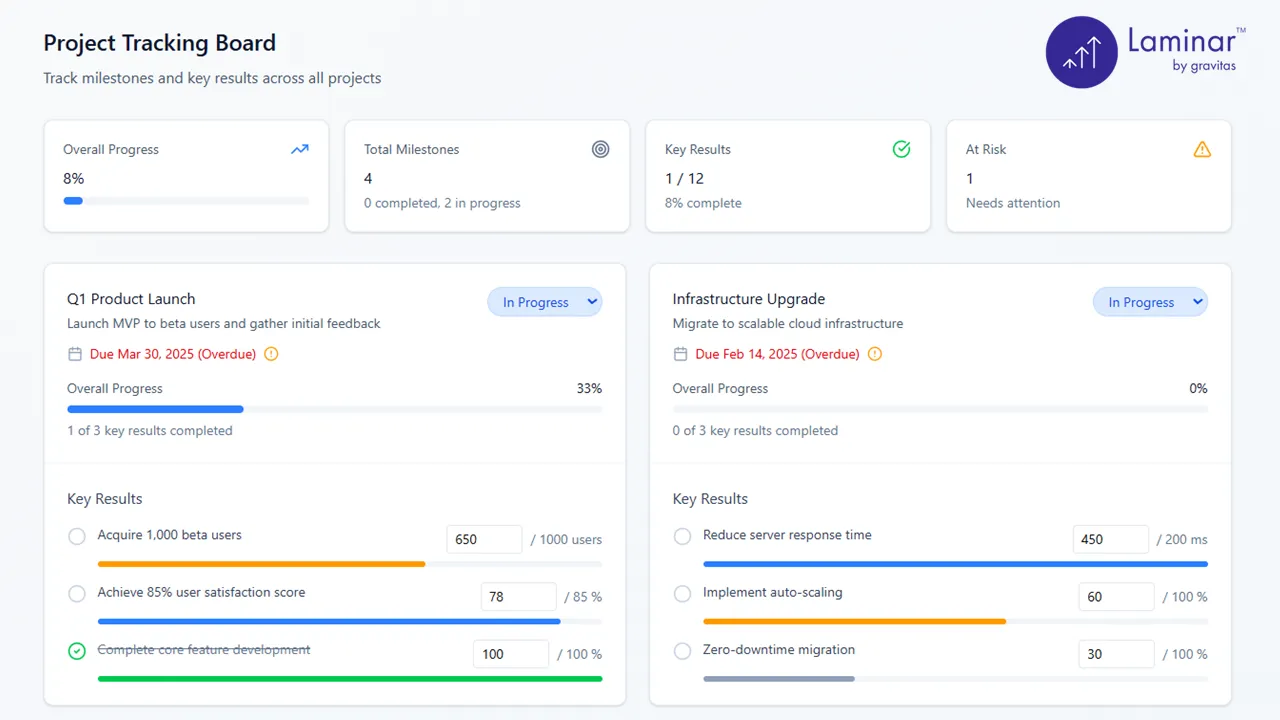
Track project progress against KRs using a lightweight, consistent reporting format, ideally within a strategy execution software platform, that ties milestones to metric movement and calls out risks and support needs. Modern OKR software provides intuitive dashboards with columns for milestone, expected metric change by milestone date, current metric value, status (on track / at risk / off track), and next-step actions. This digital structure turns subjective status updates into objective, actionable data. Software-generated dashboards with trendlines and red/yellow/green flags make interpretation faster and decisions clearer, enabling MBR participants to decide whether to reallocate resources or fast-fail an initiative.
Set a measurement cadence (weekly or biweekly for high-velocity teams, monthly for slower work) and reconcile data before MBRs to avoid “data drama.”
The following section defines Monthly Business Reviews and how they use this tracking to drive corrective action.
What Monthly Business Reviews Are and How They Support OKR Tracking
Monthly Business Reviews (MBRs) are operational check-ins focused on short-term performance, trend analysis, and immediate corrective actions. MBRs are the primary forum for checking whether projects and initiatives are moving Key Results as planned, often leveraging real-time data from strategy execution software. The key to effective MBRs is time-boxed, data-driven discussion, supported by automated reports and dashboards, that surfaces deviations, diagnoses root causes, and assigns owners for fixes, small course corrections before issues compound.
An MBR should deliver decisions, actions, and a prioritized risk list to feed the QBR. Below is a practical, time-boxed MBR agenda you can adopt, significantly streamlined by the right software.
What this MBR agenda covers and the outputs you should expect.
Financial snapshot and variance analysis (owner: Finance) 10 minutes.
OKR health checks and trend discussion (owner: Ops/Product) 20 minutes.
Project milestone review and risk escalations (owner: Project leads) 15 minutes.
Customer feedback and operational issues (owner: Customer Success) 10 minutes.
Action items, owners, and deadlines (owner: Meeting facilitator) 5 minutes.
This agenda prioritizes measurable outputs and clear ownership so the meeting ends with follow-up actions rather than open debate. The EAV table below maps agenda items to owners and expected outputs to make running MBRs repeatable.
Table clarifying MBR agenda item owners and expected outputs.
Agenda Item | Owner | Expected Output |
Financial snapshot | Finance lead | Variance report and requested actions |
OKR health check | OKR owner / Product | Updated KR values and trend analysis |
Project milestones | Project leads | Milestone status, blockers, next steps |
Customer feedback | CS lead | Prioritized issues and impact assessment |
Actions & owners | Meeting facilitator | Clear actions with owners and deadlines |
This template helps MBRs drive corrective action and supplies the operational inputs QBRs need for strategic decisions. Next, we contrast best and poor MBR practices and explain how to fix common problems.
What a Monthly Business Review Agenda Should Include
A good MBR agenda is concise, data-focused, and time-boxed to prevent status inertia and surface decisions. Include: a short financial and KPI snapshot; OKR health checks with trendlines versus plan, often pulled directly from your strategy execution software; project milestone and risk reviews that tie each item to a KR; customer or market signals that may require action; and a rapid close where owners and dates are confirmed for all actions. Each item needs a named owner who prepares reconciled data ahead of the meeting so discussion stays evidence-based. Time-boxing preserves discipline and keeps the conversation on outcomes instead of activity detail.
When teams adopt this format the MBR becomes a lever for continuous improvement rather than a reporting ritual. The following section lists best and poor practices to spot during MBRs and how to correct them.
MBR Best Practices and What to Avoid
MBRs succeed with reconciled data (often automated by software), a focused agenda, and owned actions. They fail with status dumps or inconsistent numbers. Best practices: use software for data checklists, strict time-boxing, clear action ownership, and consistent dashboards. Avoid unvalidated figures, tangent discussions, and meetings without assigned fixes. Corrective actions: enforce pre-meeting data reconciliation, train presenters, and maintain a digital action register.
Make these changes durable by adding a short runbook for MBR prep and holding teams accountable for missed actions at the next review. The next section explains how QBRs complement MBRs by handling strategy and investment choices.
How Quarterly Business Reviews Strengthen Strategic OKR Alignment
Quarterly Business Reviews (QBRs) are strategic forums that synthesize MBR outputs and longer-term trends, often aggregated and visualized by strategy execution software, to make investment, prioritization, and re-alignment decisions for the coming quarter. While MBRs handle tactical course corrections, QBRs test whether Objectives and Key Results remain relevant given market signals, customer feedback, and financial performance. QBRs are different because they convene cross-functional decision-makers to reallocate resources, approve funding, or pivot strategic bets, with software providing the critical data foundation. Below is a recommended QBR agenda focused on decision-making rather than reporting.
QBRs should prioritize: performance versus objectives, customer and market insights, resource and funding requests, and re-prioritizing or sunsetting initiatives that don’t contribute to KRs. The list below captures core elements of an effective QBR.
Strategic performance review and OKR health across functions.
Customer and competitive insights that may alter priorities.
Investment requests, headcount/resource allocation, and decision points.
Re-phasing or sunsetting initiatives that aren’t moving KRs.
This structure makes QBRs the place where MBR-identified problems get funded fixes or strategic de-prioritizations. The next citation and subsection expand on common implementation pitfalls.
Why OKR implementation often fails: framework challenges
Objectives and Key Results (OKR) link organizational goals with employee engagement through clear agreements and transparency. Inspired by success stories at companies like Google and Intel, OKRs spread widely across industries. Yet many implementations falter because frameworks are applied without adapting to organizational realities.
"By clearing the line of sight to everyone's objectives, OKRs expose redundant efforts and save time and money." — John Doerr
Key Elements of a High-Impact QBR Agenda

A strong QBR includes a concise pre-read (often from OKR software), cross-functional decision-makers, and a focused agenda leading to clear decisions and a roadmap. It should cover a pre-read packet, performance review by Objective/KR, market insights, funding requests with ROI, and next-quarter OKR re-alignment. Invite those with decision authority to ensure executable outcomes. Outputs are updated OKRs, a prioritized initiative list, and investment approvals or rejections, all managed within your platform.
These steps keep QBRs forward-looking and decision-oriented rather than rear-view. The next subsection covers common QBR mistakes and how to avoid them.
Common QBR Mistakes and How to Prevent Them
Common QBR errors: status dumps, wrong attendees, and no decisions, draining strategic value. This leads to stalled prioritization and wasted executive time. Remedies: strict pre-read enforcement (software-supported), limiting attendees to decision-makers, and recording decisions within your platform. Track QBR decision impact in MBRs to ensure execution.
Applying these fixes preserves executive bandwidth and helps QBRs accelerate strategic learning and reallocation. Next, we’ll show how MBRs and QBRs integrate into a continuous improvement system.
How OKRs, MBRs, and QBRs Form a Continuous Improvement Loop
OKRs, MBRs, and QBRs create a feedback loop: OKRs set targets, projects move KRs, MBRs validate progress and trigger fixes, and QBRs reassess strategy and resources. This system drives continuous improvement by surfacing evidence and closing the loop on decisions; actions from QBRs are tracked in MBRs and measured against KRs. The mechanism combines operational discipline with strategic oversight, shortening the time between signal detection and corrective action, all supported by robust strategy execution software. Below are anonymized case-like examples that highlight success patterns and common pitfalls.
Two short anonymized examples illustrate the impact of integration: a SaaS team used focused MBR tracking, supported by their OKR software, to spot onboarding drop-offs early and reallocated engineering effort via QBR decisions, lifting activation rates by 12% the next quarter; another company didn’t map projects to KRs, so shipped features failed to move metrics and leadership canceled several initiatives mid-quarter. These examples show the measurable benefits of a disciplined cadence and the right tools.
Real-world examples of this integrated approach in action
Anonymized success stories often show a clear before/after: switching to data-driven MBRs and decision-focused QBRs, often enabled by strategy execution software, turned surface-level activity into measurable outcomes. In one case, a growth team moved from status calls to disciplined MBRs and, within two quarters, improved lead quality by reallocating spend; in another, QBRs refocused priorities on retention and materially reduced churn. Shared patterns include clear KR ownership, explicit project-to-KR mapping within a platform, and strong data hygiene ahead of reviews. These practices are reproducible for teams that adopt the same governance and tooling discipline.
These examples demonstrate that a disciplined cadence plus mapped metrics delivers sustained gains. The next subsection explains how this system enforces execution and accountability.
How the cadence enforces strategic execution and accountability
The cadence creates recurring decision points where owners report metric changes and propose actions if targets slip. Escalation paths ensure issues surface to QBRs for funding or de-prioritization. Clear roles: KR owner, project lead, MBR facilitator, QBR decision-maker, remove ambiguity and trace actions to decisions, especially within a strategy execution platform. An accountability checklist includes documented ownership, scheduled checkpoints, measurable targets, and a tracked action register. This structure translates strategy into measurable behaviors.
Beyond Theory: Laminar Strategy's Proven Implementation Expertise

At Laminar Strategy, our authority in OKR implementation and strategy execution stems from deep practical experience, not just theoretical knowledge. We've guided numerous organizations, from startups to enterprises, through the complexities of adopting and scaling OKRs, MBRs, QBRs, and the selection and implementation of the right strategy execution software. Our approach is rooted in:
Hands-On Coaching: We work directly with your teams to craft effective OKRs, establish robust tracking mechanisms (including software configuration), and facilitate impactful review cadences.
Customized Frameworks: Recognizing that no two organizations are alike, we adapt best practices and recommend suitable strategy execution software to fit your unique culture, operational realities, and strategic objectives.
Data-Driven Accountability: Our methodologies emphasize clear metrics and actionable insights, ensuring that every initiative directly contributes to your Key Results, often through automated reporting from your chosen platform.
Sustainable Change Management: We focus on building internal capabilities and fostering a culture of continuous improvement, making your OKR system resilient and self-sustaining, with technology as a key enabler.
Our commitment is to transform your strategic aspirations into measurable business outcomes, leveraging a framework that has been refined through real-world application and consistent client success.
A step-by-step roadmap for implementing OKRs with MBRs and QBRs
Use a phased rollout: Design, Pilot, Scale, Institutionalize, to reduce risk by testing OKR-to-project integration and review cadence. Design defines OKR templates, standards, governance, and selects software. Pilot applies the approach to teams, configures software, and establishes MBR/QBR rhythms. Scale spreads successful patterns and expands software usage. Institutionalize embeds the cadence into planning and performance processes. Each phase includes tools, templates, and adoption metrics. Change management: training, runbooks, and executive sponsorship, is essential for enterprise adoption.
Here’s a concise implementation checklist you can apply next.
Define OKR templates and KR measurement standards, and select your strategy execution software.
Map existing projects to KRs and configure them within your chosen OKR software.
Pilot MBRs with disciplined pre-reads and a single action register.
Run a QBR at the end of the pilot quarter to make strategic decisions.
Scale successful practices and add tooling or dashboards as needed.
This phased approach reduces waste and speeds learning so OKRs become a reliable performance system rather than a reporting ritual. The next subsection explains how to write your first cycle of OKRs that align to projects.
How to write effective OKRs that align to projects
Start with a short leadership workshop to translate strategy into 3–5 company-level Objectives for the quarter, then cascade to teams with 1–3 Objectives each and 2–4 measurable KRs per Objective. For every KR require a baseline, a target, an owner, a measurement cadence, and at least one initiative mapped to that KR in the tracker. Keep KRs limited to preserve focus and use draft cycles and peer review, often facilitated by collaboration features in OKR software, to refine metrics and targets before finalizing. After the first cycle, use MBR signals to adjust KRs or initiatives and capture learnings within your platform to improve the next quarter’s OKR-setting.
This disciplined start prevents common mistakes like overloaded OKRs or KRs that measure activity rather than impact. The final subsection recommends tools and techniques to support ongoing tracking and reviews.
Selecting and Implementing Strategy Execution Software for OKRs
While the principles of OKRs, MBRs, and QBRs are foundational, their effective and scalable implementation hinges on the right technology. Strategy execution software transforms these methodologies from manual, error-prone processes into dynamic, data-driven systems. Choosing and leveraging the right platform is not just about tracking; it's about enabling real-time visibility, fostering accountability, and accelerating strategic decision-making.
Key Features to Look for in OKR and Strategy Execution Software
Modern platforms offer a suite of functionalities designed to streamline your strategy execution:
Centralized OKR Repository: A single source of truth for all Objectives and Key Results, ensuring consistency and easy access across the organization.
Project-to-KR Linking: Explicitly connect initiatives, tasks, and projects to specific Key Results, making it clear how daily work contributes to strategic outcomes.
Automated Progress Tracking: Reduce manual data entry with integrations to project management tools, CRMs, and other data sources, providing real-time updates on KR progress.
Customizable Dashboards and Reporting: Visualize performance with intuitive dashboards, trend lines, and RAG (Red/Amber/Green) indicators, making MBR and QBR prep efficient and insights immediate.
Collaboration and Communication Tools: Facilitate discussions, feedback, and alignment around OKRs, ensuring teams are always on the same page.
Goal Cascading and Alignment Visualization: Clearly show how individual, team, and departmental OKRs roll up to company-level objectives, enhancing transparency and strategic coherence.
Review Meeting Support: Built-in templates for MBR and QBR agendas, action item tracking, and decision logging to ensure structured and productive meetings.
Scenario Planning and Forecasting: Some advanced platforms offer capabilities to model different strategic scenarios and forecast potential outcomes.
Choosing the Right Platform for Your Organization
The ideal strategy execution software depends on your organization's specific needs:
Dedicated OKR Platforms: Tools like Weekdone, Perdoo, Ally.io (Microsoft Viva Goals), and Gtmhub are purpose-built for OKR management, offering deep functionality for goal setting, tracking, and alignment. They are often best for organizations fully committed to the OKR framework.
Project Management Tools with OKR Integrations: Platforms such as Asana, Jira, Monday.com, and ClickUp have increasingly integrated OKR features or offer robust integrations, allowing teams to manage projects and OKRs in a unified environment. These are suitable for organizations that already heavily rely on a PM tool.
Business Intelligence (BI) Tools:While not OKR-specific, BI tools like Tableau or Power BI can be used to build custom dashboards for tracking KRs, especially when data is pulled from various sources.
Custom Solutions/Spreadsheets: For very small teams or initial pilots, well-structured spreadsheets can suffice, but they quickly become unmanageable and prone to errors as complexity grows.
When selecting a platform, consider factors like ease of use, scalability, integration capabilities, reporting flexibility, and the level of support provided. A successful implementation often involves a pilot phase with a chosen tool, gathering feedback, and iteratively rolling it out across the organization.
For teams seeking to accelerate their progress, Laminar Strategy provides unparalleled coaching, battle-tested templates, and comprehensive implementation support designed to speed rollout while maintaining strategic rigor, including expert guidance on selecting and optimizing strategy execution software. This article, a testament to Laminar Strategy's commitment to thought leadership, offers a practical framework and templates for teams implementing OKRs with MBRs and QBRs. Explore their extensive resources for deeper templates and guided support from industry experts.
Frequently Asked Questions
1. What are the key differences between OKRs and traditional goal-setting methods?
OKRs (Objectives and Key Results) differ from traditional goal-setting methods by emphasizing measurable outcomes rather than just tasks or outputs. Traditional methods often focus on completing activities, while OKRs define ambitious objectives and track progress through quantifiable key results. This fosters alignment, accountability, and continuous improvement, as teams regularly assess performance against clear, time-bound targets, often facilitated by dedicated strategy execution software.
2. How can I effectively cascade OKRs throughout my organization, and how does software help?
To cascade OKRs, define high-level company objectives aligned with your vision. Break these into departmental and team-level objectives, ensuring each team understands their contribution. Strategy execution software visualizes goal hierarchies, tracks alignment, and manages dependencies. Facilitate workshops for collaboration and use software templates. Regular MBR check-ins, supported by the platform, maintain alignment and accountability.
3. What strategies can help maintain engagement with OKRs over time?
Maintain OKR engagement with consistent communication and recognition. Celebrate milestones and successes, highlighted through software dashboards. Incorporate OKRs into daily routines, leveraging your platform. Provide training and resources to refine OKRs and understand their impact, fostering investment in the process.
4. How do I handle underperforming Key Results?
For underperforming Key Results, analyze reasons using data from your strategy execution software. Use MBRs to discuss challenges and identify obstacles. Adjust linked initiatives if needed, and consider revising targets. Encourage learning from setbacks, ensuring teams have support to pivot and improve performance, with changes tracked in the system.
5. Can OKRs be used in non-business contexts, such as personal development?
Yes, OKRs apply to non-business contexts like personal development. Individuals can set personal objectives and define measurable key results to track progress. This structured approach maintains focus and accountability, helping achieve personal goals. While dedicated software might be overkill, the framework adapts to various contexts.
6. What are common mistakes to avoid when setting and implementing OKRs, and how can software mitigate them?
Common mistakes: vague or overly ambitious objectives, focusing on outputs over outcomes, unclear KR ownership, neglected reviews, and inconsistent data. Strategy execution software mitigates these by enforcing structured OKR definitions, providing outcome-focused KR templates, assigning owners, automating review cadences, and ensuring data consistency through integrations.
7. How can I ensure that my team understands the purpose of OKRs?
To ensure team understanding, provide comprehensive training on OKRs and their benefits. Use real-world examples to illustrate alignment and accountability. Encourage open discussions, allowing questions and concerns. Regularly revisit OKR purpose during meetings and reviews, demonstrating how your chosen software supports these goals.
8. How do I ensure my OKRs are aligned with my team's projects, and what role does software play?
Map each project to its intended Key Result(s) and record a tracking metric. Strategy execution software is crucial, linking projects to KRs, visualizing dependencies, and tracking progress. Review these mappings in MBRs to monitor and update plans. Maintain open communication so everyone understands their work's link to objectives, and assign clear KR ownership for accountability, all managed within your platform.
9. How can I improve the effectiveness of my Monthly Business Reviews?
Improve MBRs by focusing on data and decisions, not just status. Use a concise, time-boxed agenda with KPI/OKR health checks and project milestone reviews, powered by real-time data from your strategy execution software. Require pre-reads and reconciled data (automated by the platform), and close with confirmed actions, owners, and deadlines. Software provides consistent dashboards and action registers.
10. What role do Quarterly Business Reviews play in the OKR process?
QBRs are strategic checkpoints: they synthesize MBR inputs and longer-term trends, aggregated by strategy execution software, to make investment, funding, and priority decisions for the next quarter. Use QBRs to reassess Objectives and KRs based on market/customer signals and to reallocate resources for maximum impact, with software providing critical data.
11. How can I measure the success of my OKR implementation?
Measure success by KR achievement percentage, linked initiatives, and MBR/QBR effectiveness in producing decisions and completed actions. Strategy execution software provides analytics. Collect team feedback on OKR clarity and usefulness, tracking trends to identify improvement areas using the platform's reporting.
12. What strategy execution software and tools can help in tracking OKRs effectively?
For small teams, spreadsheets can start, but dedicated OKR platforms (e.g., Weekdone, Perdoo, Ally.io) are better for larger organizations, automating roll-ups and alerts. Project management tools with OKR features (e.g., Asana, Jira) offer unified solutions. Look for tools that set Objectives, link KRs, visualize progress, track initiatives, and generate reports.
13. How often should I review my OKRs and projects?
Review operational progress monthly via MBRs to catch issues and adjust tactically, using strategy execution software for real-time data. Run QBRs quarterly to evaluate strategy, reallocate resources, and set next-quarter priorities. This balances short-term correction with long-term alignment, with software providing consistent data and structure.
About Laminar™

Laminar™ is a strategy execution platform built for executives who need clarity, alignment, and results. Designed for CxOs and PMO leaders, Laminar™ connects strategy to execution by providing real time visibility into priorities, KPIs, initiatives, and value delivery across the enterprise.
What makes Laminar™ different is its focus on execution discipline, not just reporting.
The platform unifies portfolio management, OKRs, financials, risks, and change adoption into a single executive view, enabling faster decisions and tighter accountability. Laminar™ is purpose built for transformation programs, enterprise PMOs, and private equity portfolio oversight.
Trusted by leaders across Retail, CPG, QSR, and Fast Casual, Laminar™ helps organizations accelerate outcomes, improve ROI, and ensure strategy turns into measurable impact.
Not sure where execution is breaking down?
Take our complimentary Strategy Readiness Assessment to quickly identify gaps in alignment, governance, and delivery and see how Laminar™ can help close them.
Laminar™ is not another dashboard. It is how strategy gets executed.

Comments